The Advantages of Private School
by Admin
Posted on 11-10-2024 08:11 AM

The age-old question of where to send your child to school, if you’re fortunate enough to have a choice, is one that has been debated for ages. Do you go the
private school
route to give your child smaller class sizes, more rigorous learning experiences, and a better shot at an upper-tier college? or do you opt for the public school option, where your child will experience more diversity among their classmates and have more opportunities for exploring academic and extracurricular activities? no doubt, private schools, and public schools have their advantages and disadvantages , which help create a vastly different school experience for your child.
Feb 8 2016 are you facing the tough decision between sending your child to a top private middle school or private high school, or sending them to the local public school? there are advantages and disadvantages to each option, and we'll explore them below: private school advantages private high school and private middle school curricula are usually more focused on specialized topics (like the creative arts) that prepare students for careers and higher education in a chosen field. Class sizes are smaller, the student-to-teacher ratio is lower, and coursework is more challenging. Most private schools have access to better books, supplies and classroom technology.
The Disadvantages of Private Schools
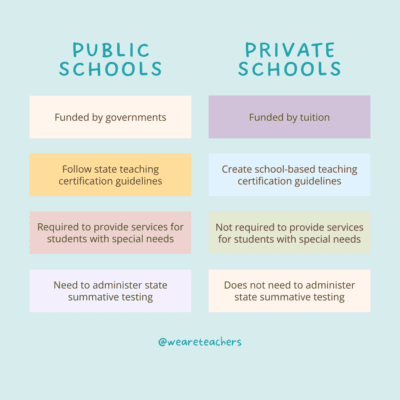
When it comes to education, the variety of options available to parents today can be overwhelming. Two primary categories of schools that often come under scrutiny are private and public institutions. Private schools are privately funded and typically require tuition payments, while public schools are funded by taxpayers and are generally tuition-free. Each type of school comes with its own set of advantages, disadvantages, and nuances. While deciding between private and public schools, parents must weigh several essential factors.
These include academic quality, cost considerations, the learning environment, extracurricular opportunities, support for special needs, and parental involvement. Each of these elements can play a pivotal role in shaping a child's educational experience.
Government schools vs private schools essay , debate, speech | advantages of private schools | disadvantages of private schools | advantages of government schools | disadvantages of government schools | government schools vs private schools debate schools are the temples of knowledge and it is the place where a student grows up to be a scholar. Education is the backbone of development of a country and therefore developing this sector is always a part of great consideration by the government. However the question is that which of the two schools are better: government or private? for a few students, either of the choice of school does not matter.
Fretting about public vs. independent kindergarten
Kindergartens are usually run by private organizations, but they may also be run by public schools or religious organizations. Kindergartens typically follow a different curriculum than public or private schools, and they do not have to meet the same standards as public or private schools. However, just like with private schools, an independent kindergarten must still meet certain standards set by its accrediting body.
What is a private school? a private school is a private business or nonprofit entity that offers or conducts full-time instruction with a full complement of subjects at the elementary, middle, or high school level. Private schools function outside the jurisdiction of the california department of education (cde) and most state education regulations. Private schools do not participate in california’s educational accountability system and are directly accountable to students and their parents or guardians, based on the terms of the private school enrollment contract. Information on the definitions of public and private schools is on the cde web page definition of a school.
Virtually every child in america goes to school. Approximately 9% of these children attend a private school. These are schools that are not bound by state regulations and are privately funded, usually by charging tuition. They are generally considered better than their public counterparts: a gallup poll found that in 2017, 71% of its respondents felt that independent private schools and 63% felt that parochial schools (basically religious private schools) do an excellent or good job educating children, compared with 44% for public schools. Education statistics seem to justify the public’s confidence in private schooling. The national center for education statistics (nces) analyzed standardized testing scores for grades 4 and 8, and found that private school students, on average, scored higher than public school students.